
















.png)
Summary. A Human Resource Information System (HRIS) is a digital platform that centralizes employee data, automates payroll and compliance, and streamlines every HR process from recruitment to offboarding. In the Philippines, where employers must navigate SSS, PhilHealth, Pag-IBIG, and BIR requirements alongside DOLE-mandated pay rules, the right HRIS replaces manual processes with automated accuracy — and frees your HR team to focus on your people, not paperwork. This guide covers the top HRIS systems Philippines businesses use in 2027, with real examples, a side-by-side comparison table, pricing, and a practical checklist for choosing the right platform for your team.
Filipino businesses are increasingly turning to HR technology to manage growing workforces, meet complex regulatory requirements, and stay competitive in a market where 51.69 million workers are part of the Philippine labor force. According to IMARC Group, the Philippines HR technology market reached USD 774.3 million in 2025 and is projected to nearly double to USD 1.45 billion by 2034, growing at a CAGR of 7.24%. Yet many teams are still relying on spreadsheets or disconnected tools that create compliance gaps and administrative drag.
A Human Resource Information System (HRIS), also called HRIS software or an HRIS system, is a centralized digital platform that manages employee data, automates payroll calculations, tracks attendance and leave, processes government contributions, and supports every stage of the employee lifecycle. In the Philippines, the best HRIS systems go further: they automate SSS, PhilHealth, Pag-IBIG, and BIR withholding calculations, generate DOLE-compliant reports, and update automatically when government rates change.
This guide walks you through the top HRIS Philippines companies are using in 2027 — with a full comparison table, real examples, vendor profiles, and a practical framework for making the right choice for your team.
Learn more: What is HRIS? Why HR Needs Automation
Top HRIS Systems Philippines: Quick Comparison
What is an HRIS System?
An HRIS (Human Resource Information System) is a software platform that acts as a central source of truth for all employee data and HR processes. It collects, stores, and manages information like employee records, compensation, attendance, benefits, and compliance documents — and uses that data to automate HR workflows across the employee lifecycle.
In the Philippines, an HRIS system handles:
- Employee records management (201 files, visa status, compensation history)
- Attendance and time off management
- Payroll processing with automated SSS, PhilHealth, Pag-IBIG, and BIR deductions
- Onboarding, recruitment, and applicant tracking
- Performance management and 360° reviews
- Document management and e-signatures
- Employee self-service portals
- Reports and analytics for workforce decisions
HRIS vs HRMS vs HCM: What's the Difference?
These three terms are often used interchangeably, but they're not the same thing:
HRIS (Human Resource Information System) focuses on data management, record-keeping, and automating core HR processes like payroll, leave, and attendance. It's the foundation most companies start with.
HRMS (Human Resource Management System) expands on HRIS by adding management functionality — performance reviews, training and development, and more sophisticated workflow automation. Think of it as HRIS plus active people management tools.
HCM (Human Capital Management) is the most comprehensive category. It includes everything in HRIS and HRMS, plus strategic capabilities for workforce planning, succession management, compensation benchmarking, and long-term talent development.
For most mid-sized Philippine companies, a modern HRIS with strong payroll and compliance automation covers the vast majority of daily operational needs, with performance and recruitment modules often included.
What are the 5 types of HRIS systems?
All HRIS systems share some valuable benefits—automation that saves you time, self-service features that empower your team, centralized databases that keep everything organized, and talent management tools that help your people thrive.
But beyond these basics, each type of HRIS brings something unique to the table. Let's explore the five types to help you discover which one fits your team's specific needs.
1. Operational HRIS: Your Day-to-Day Companion
What it does: Manages the fundamentals — employee records, position data, time off, and payroll. Automates routine administrative workflows so HR teams spend less time on data entry.
Best for: Organizations of any size that want to eliminate manual HR tasks and maintain a clean, centralized employee database.
Philippine relevance: Operational HRIS handles the day-to-day statutory compliance that Philippine teams need — SSS deductions, PhilHealth contributions, BIR payslip generation — automatically and accurately.
2. Tactical HRIS: Your Resource Optimization Partner
What it does: Supports resource planning decisions — recruitment, compensation benchmarking, training needs, and vacancy management. Combines internal data with external benchmarks.
Best for: Organizations focused on optimizing talent acquisition and people investment decisions.
3. Strategic HRIS: Your Future-Focused Ally
What it does: Enables forward-looking workforce planning through goal-setting tools, scenario modeling, and market data integration. Turns HR data into business strategy inputs.
Best for: Growing companies using HR data to plan expansion, headcount scaling, or organizational restructuring.
4. Comprehensive HRIS: Your All-in-One HR Hub
What it does: Combines operational, tactical, and strategic capabilities into one unified platform — covering everything from payroll to performance to succession planning.
Best for: Mid-sized to enterprise organizations that want a single system managing the entire HR and payroll lifecycle without stitching together multiple tools.
Philippine relevance: Omni HR and Sprout Solutions are examples of comprehensive HRIS platforms built specifically for Philippine compliance requirements.
5. Limited-Function HRIS: Your Specialized Solution
What it does: Focuses on one specific HR function — such as payroll-only software, a standalone timekeeping system, or a dedicated applicant tracking system.
Best for: Smaller teams or companies with a very specific gap to fill without needing a full-stack solution.
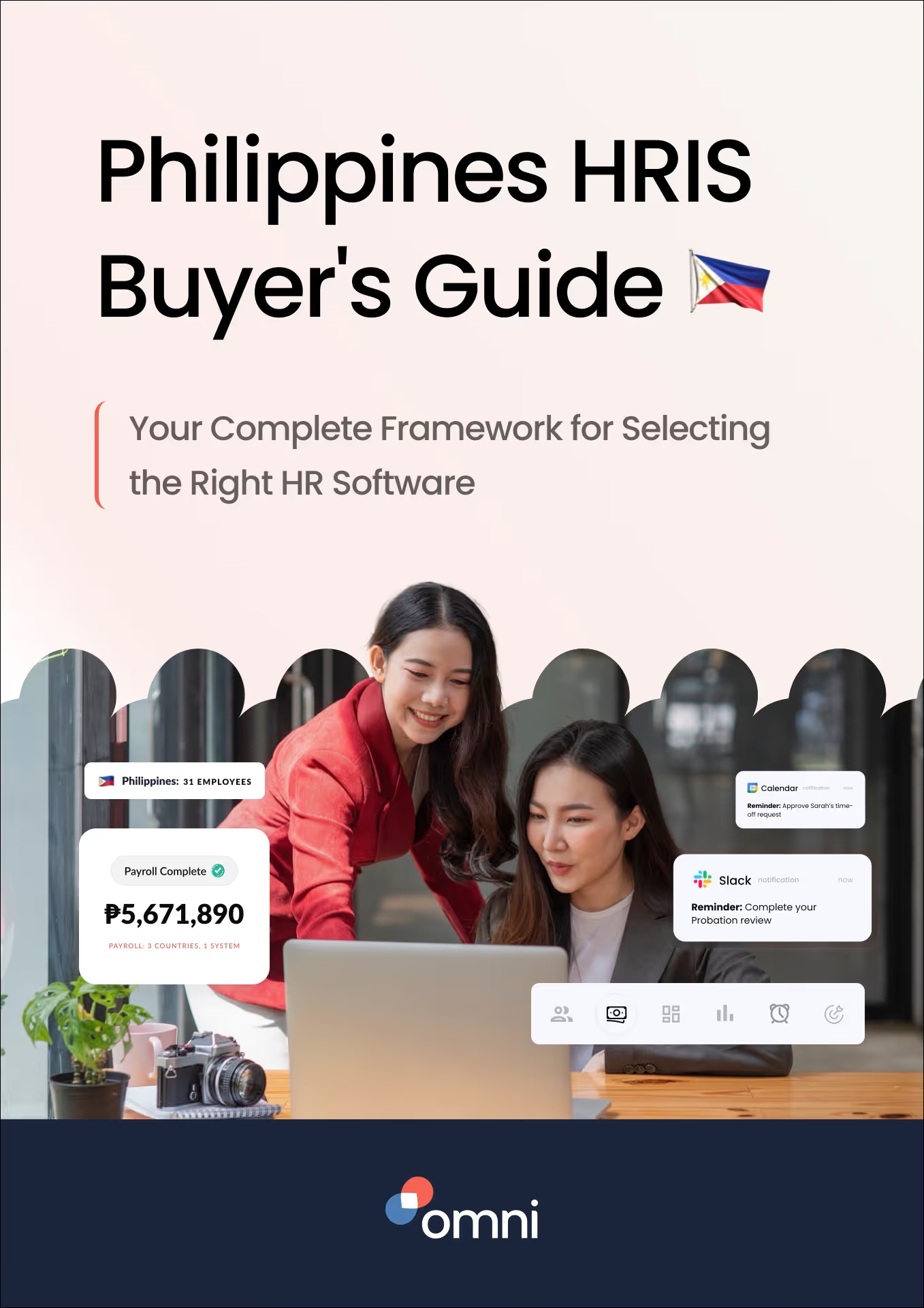
Ready to assess your needs? Our Philippines HRIS Buyer's Guide helps you assess your pain points, evaluate vendors and reach a final decision.
Top HRIS Systems Philippines

1. Omni HR
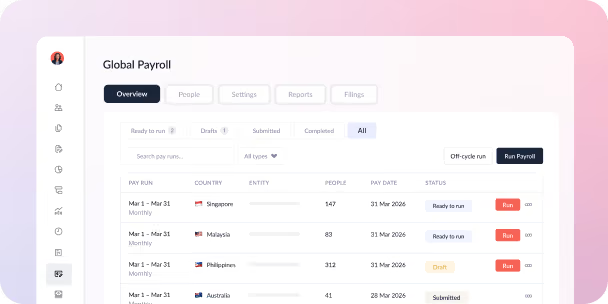
Omni is an AI-powered comprehensive HRIS and multi-country payroll platform built for modern teams across Asia, combining deep Philippine compliance automation with the scalability to manage multi-country workforces. It automates the full employee lifecycle — from recruitment and onboarding to payroll and offboarding — with localized statutory compliance at its core.
Key features:
- Automated SSS, PhilHealth, Pag-IBIG, and BIR withholding calculations
- Full HRIS suite: employee database, time off, attendance, performance management, recruitment (ATS)
- Multi-country payroll supporting 200+ countries and 10+ languages
- Employee self-service portal and mobile app (iOS and Android)
- Advanced reporting and analytics with custom dashboards
- Workflow automation for approvals, reminders, and task sequences
- Document management with e-signatures
- AI-powered workflows and agentic AI features
- AES-256 encryption and ISO 27001-certified data centers
- Local APAC support team operating in your time zone
Pros:
- Best for mid-sized companies with regional presence or SEA expansion plans
- In-platform compliance automation — no manual workarounds for PH statutory requirements
- Highly responsive local support with dedicated onboarding and account management
- Extensive Philippine and SEA HR content library (guides, webinars, compliance updates)
- Flexible, modular platform that adapts to your workflows
Cons:
- May have limitations for highly bespoke or enterprise-level custom workflow requirements
Best for: Mid-sized Philippine companies that need reliable local compliance, full HRIS functionality, and the ability to scale across Southeast Asia from one platform.
Pricing: Starts from $3 per employee per month.
"Omni's highly adaptable and customizable HRIS empowers us to easily manage our distributed workforce across existing and future countries of operation. The intuitive interface and automated workflows streamline our processes, saving us time and minimizing errors."
— Lovely Tan, Philippines Country Head of People, Qashier
2. Sprout Solutions
Sprout is the Philippines' largest homegrown HR and payroll platform, serving 1,800+ clients nationwide. Built specifically for the Philippine market, it offers deep local compliance automation alongside a growing suite of AI-powered and financial wellness features.
Key features:
- One-click generation of government forms (BIR Form 2316, SSS, PhilHealth, Pag-IBIG reports)
- AI-powered payroll processing and HR concierge
- Earned Wage Access (EWA) and financial wellness integrations
- Timekeeping, attendance, and leave management
- Performance management and people analytics
Pros:
- Deepest Philippine-specific compliance coverage of any local provider
- Strong analytics and reporting suite
- Ecosystem of financial wellness tools built for Filipino employees
Cons:
- Philippines-only; no multi-country payroll support
- Higher pricing can be excessive for smaller and mid-market teams
- Some advanced features designed for enterprise-scale organizations
Best for: Philippine-only enterprises and large SMEs that prioritize maximum local compliance depth and don't have SEA expansion plans.
Pricing: Starter from PHP 5,000/month for up to 10 employees.
3. peopleHum
PeopleHum is a people-centric HRIS platform with a strong focus on talent management, employee engagement, and performance. It offers an integrated suite covering the full hire-to-retire lifecycle.
Key features:
- AI-driven applicant tracking system (ATS)
- Employee engagement surveys and social intranet
- Performance management with 360° feedback and goal-setting
- Leave and attendance management
- HR analytics and reporting
Pros:
- Intuitive, modern user interface
- Strong recruitment and engagement capabilities
- Winner of SF Global Codie Awards 2019
Cons:
- Philippine statutory payroll compliance requires third-party integration
- Onboarding and implementation can be complex for some teams
- Less suited to payroll-as-primary-driver use cases
Best for: Companies prioritizing talent acquisition, employee engagement, and performance management, with payroll handled via a separate integration.
Pricing: Core plans from approximately $2 per employee per month.
4. GreatDayHR
GreatDay HR is a mobile-first, cloud-based HRIS designed to simplify HR and payroll for Philippine SMEs and distributed teams. Its strength is accessibility — employees can manage their HR needs from any device, anywhere.
Key features:
- Mobile-first attendance and time tracking
- Leave and scheduling management
- Payroll processing with core Philippine compliance
- Employee self-service portal
- Basic analytics and dashboards
Pros:
- Excellent for frontline workers, field teams, and shift-based operations
- Fast to set up; minimal training required
- Affordable for small and growing teams
Cons:
- Limited customization for complex workflows
- No multi-country payroll support
- Reporting depth may not meet mid-market needs
Best for: Philippine SMEs and mobile-first teams that need straightforward HR and payroll without complexity.
Pricing: From PHP 70 per day.
5. PayrollHero
PayrollHero is a time, attendance, scheduling, and HRIS platform built for the Philippines, with facial recognition technology for employee accountability. It's particularly suited to industries where tracking shift accuracy is critical.
Key features:
- Facial recognition time tracking
- Leave and attendance management
- Payroll processing with PH compliance
- Scheduling and shift management
- Employee database
Pros:
- Strong attendance accuracy for hourly and shift-based workforces
- Well-suited to retail, hospitality, and BPO operations
- Cloud-based with mobile access
Cons:
- Feature set is more limited than full-suite competitors
- No multi-country payroll
- Facial recognition setup requires hardware investment
Best for: Businesses with shift-based or time-sensitive workforces that need precise, biometric-verified attendance data integrated with payroll.
Pricing: Custom pricing based on headcount.
6. HReasily
HReasily is a straightforward HR platform built for SMEs in Southeast Asia, offering core HR and payroll functions at an accessible price point. It covers the essentials without the complexity of enterprise systems.
Key features:
- Employee self-service portal
- Payroll management with PH compliance
- Mobile access
- Payslip generation
- Salary adjustment and basic HR workflows
Pros:
- Affordable and easy to implement
- Mobile-friendly for on-the-go teams
- Covers essential HR operations without heavy setup
Cons:
- Limited advanced features for scaling organizations
- Reporting and analytics are basic compared to full-suite platforms
- Integration capabilities more limited than enterprise tools
Best for: Budget-conscious SMEs that need basic HRIS and payroll coverage without a complex implementation.
Pricing: Custom pricing; contact for quote.
7. Darwinbox
Darwinbox is an Asia-origin HCM platform with a mobile-first design and strong multi-country SEA capabilities. It serves large enterprises and regional organizations that need sophisticated HR functionality across multiple markets.
Key features:
- Full HCM suite: HRIS, payroll, performance, recruitment, and learning
- Native payroll support for five SEA countries including the Philippines
- AI-powered analytics and workforce planning
- Mobile-first interface with strong employee experience focus
- Integration with third-party ERP and finance systems
Pros:
- Strong for large organizations with complex, multi-country structures
- Modern UX with good mobile adoption
- AI-driven insights for workforce planning
Cons:
- Enterprise-grade complexity and pricing
- Implementation can take 6–12 months
- May be overbuilt for mid-market Philippine-only businesses
Best for: Large Philippine enterprises or multinationals managing HR across multiple SEA markets.
Pricing: Enterprise pricing; contact for quote.
8. BambooHR
BambooHR is a globally recognized HRIS that excels at core HR functions — employee records, time-off tracking, and applicant tracking. It's widely used by international companies with Philippine headcount, though Philippine payroll compliance requires third-party integration.
Key features:
- Employee records and 201-file management
- Time-off tracking and approvals
- Applicant tracking system
- Onboarding workflows
- Performance management and reporting
Pros:
- Very clean, intuitive interface with fast adoption
- Strong reporting and people data capabilities
- Good for globally distributed teams
Cons:
- Philippine payroll compliance (SSS, PhilHealth, BIR) requires separate payroll integration
- Not built specifically for the Philippine or SEA market
- Can become expensive at scale
Best for: Global companies with Philippine teams that already use BambooHR for core HR and manage PH payroll via a connected tool.
Pricing: From ~$10 per employee per month (custom quote required; $250/month flat rate for teams of 25 or fewer).
9. Zoho People
Zoho People is a flexible HR system that lets organizations customize workflows, forms, and approvals to fit their specific structure. It connects easily with Zoho's broader business ecosystem and a wide range of third-party tools.
Key features:
- Customizable leave, attendance, and onboarding workflows
- Performance management with goal-tracking
- Time tracking and scheduling
- Integration with Zoho Payroll and third-party apps
- Multi-location and multi-country support
Pros:
- High degree of customization for unique business structures
- Strong integration with Zoho ecosystem (CRM, accounting, projects)
- Multi-country support for regional teams
Cons:
- Philippine statutory payroll compliance requires manual configuration or a separate app
- Can require more setup time than out-of-the-box platforms
- Less specialized for PH compliance than locally built tools
Best for: Multi-location businesses already in the Zoho ecosystem, or those needing a highly customizable HRIS that can adapt to unique organizational structures.
Pricing: From $1.25 per employee per month.
10. JeonSoft
JeonSoft is one of the Philippines' oldest HR and payroll software providers, offering both on-premise and cloud-based solutions. It's a legacy platform with strong local brand recognition, particularly among enterprises that prioritize control over cloud-based accessibility.
Key features:
- Philippine payroll and compliance (SSS, PhilHealth, Pag-IBIG, BIR)
- On-premise and cloud-hosted deployment options
- Basic employee records and reporting
- Customizable pay rules and attendance configurations
Pros:
- Established local brand with years of market presence
- Familiar to Philippine HR teams used to on-premise systems
- Handles basic PH compliance requirements
Cons:
- Legacy architecture with limited modern HRIS features
- Manual updates when government rates change
- Limited scalability for growing or multi-country organizations
Best for: Philippine companies that prefer on-premise control or are maintaining existing JeonSoft deployments.
Pricing: Custom pricing; contact for quote.
Why Filipino Companies Are Leveraging HRIS in 2027

With a labor force of 51.69 million workers and one of the most complex regulatory environments in Southeast Asia, including DOLE, SSS, PhilHealth, Pag-IBIG, and BIR, Philippine businesses face real pressure to get HR and payroll right.
Time and cost savings
HRIS Philippines helps save significant time and reduce costs associated with the various manual tasks performed every day by HR and leadership. Studies have shown HR automation can decrease administrative costs by 30% for HR professionals and 49% for employers.
Routine HR workflows, such as data entry, employee onboarding, leave management, and payroll processing, are streamlined and automated, freeing up HR teams to focus on more strategic and value-added activities that drive productivity and profitability for your organization.
Discover the ROI of switching to Omni, the top HRIS for Philippines.
Calculate Your ROI with Omni
.png)


Increased efficiency and accuracy
HRIS Philippines enhances efficiency and accuracy. Manual data entry and paper-based systems are prone to errors and can be incredibly time-consuming. HR technology eliminates these issues by automating data collection, storage, and retrieval, ensuring data integrity and reducing the likelihood of errors. Additionally, the automated HR workflows HRIS Philippines offer enable faster and more streamlined processes, reducing bottlenecks and improving overall efficiency.
Learn how Omni customers have improved their HR efficiency and accuracy with our HRIS Philippines.
Improved employee experience
HRIS Philippines enhances the employee experience by providing self-service options and reducing administrative burdens. Employees can access HR systems to update personal information, view pay stubs, request leave, and access other HR workflows without relying on HR teams or managers to facilitate these simple yet time-consuming tasks. This empowers employees and gives them greater control over their HR-related activities, leading to increased satisfaction and employee engagement.
Enhanced compliance and data security
Many HR workflows involve sensitive employee information such as payroll and visa information, and compliance with data protection regulations is crucial. HRIS Philippines systems often incorporate built-in security measures, ensuring that employee data remains secure and confidential. HRIS Philippines can also help organizations stay compliant with local labor laws, regulatory requirements, and internal policies by enforcing consistent processes and providing audit trails for HR workflows.
Omni implements an AES-256 encryption standard (same as what banks use) to protect the transmission of data to our site. Our servers are located in physically secure, ISO 27001 certified data centers and we apply end-to-end encryption to ensure maximum protection to your employee data.
Our compliance-ready features make keeping your data secure from an employee level seamless. Regular compliance reporting, access controls, and consent management capabilities ensure your data is secure at every level.
Data-driven decision making
Modern HRIS platforms generate actionable data on employee performance, attrition rates, attendance trends, and workforce demographics. These insights shift HR from reactive administration to proactive strategy, giving leadership the visibility to act before problems escalate.
Scalability
As your organization grows and evolves, your HR needs also expand. HRIS Philippines provides scalability by accommodating increased employee numbers, organizational structures, and geographic locations without significant additional resources. Automated HR systems can handle a larger volume of employee data, manage complex workflows, and scale up to support the needs of your growing organization. This ensures that your HR workflows can adapt to changes and effectively support your organization’s expansion, without requiring a proportional increase in HR staff or resources.
How to Choose the Right HRIS System Philippines
With so many options available, the right HRIS is the one that fits how your team actually works. Use this checklist when evaluating providers:
Philippine statutory compliance automation
Your HRIS must automatically calculate and deduct SSS, PhilHealth, Pag-IBIG, and BIR withholding tax, and update those calculations automatically when government contribution rates change. Ask every vendor: do rate changes update automatically in the system, or do I have to apply them manually?
Payroll processing depth
Look for support for 13th-month pay, overtime pay, holiday pay, and night differential — all computed automatically based on employee records and current DOLE rules. One-click BIR report generation (Form 2316, 1601-C) separates genuinely localized systems from basic payroll tools.
Timekeeping and attendance integration
The best HRIS Philippines teams choose connects attendance data directly to payroll so hours worked, overtime, and absences are reflected in every pay cycle without manual reconciliation. Check whether the system integrates with your existing biometric devices or mobile attendance tools.
HRIS modules your team needs daily
At minimum: leave management, performance management, and attendance tracking.
For growing teams: recruitment (ATS), onboarding workflows, and document management.
Confirm which modules are included in the base price and which are add-ons.
Employee self-service and mobile access
A mobile-first self-service portal isn't optional for distributed or field-based teams. Employees should be able to view payslips, check leave balances, submit requests, and update personal information from their phones.
Multi-country payroll (if you're scaling regionally)
If you have or plan to have teams in Singapore, Malaysia, Indonesia, or elsewhere in SEA, your HRIS needs multi-country payroll capabilities built in. Switching platforms mid-expansion is expensive and disruptive.
Reporting and audit-readiness
Look for custom dashboards, exportable compliance reports, and full audit trails. Ask vendors whether custom report configurations are included in the base price or charged separately.
Local support in your time zone
When payroll is due and you have an urgent question, a 24–48-hour ticket response isn't good enough. Prioritize providers with APAC-based support teams who understand Philippine labour law and can respond same-day.
Pricing transparency as you scale
The best systems grow with you without surprising you with per-feature fees. Understand the full cost of ownership before signing: implementation, data migration, training, and any module add-ons.
Download the HRIS shopping checklist for a complete vendor evaluation framework.
Why Omni is the Top Choice for HRIS Philippines

Finding the right HRIS Philippines shouldn't mean choosing between local compliance expertise and modern capabilities. Omni delivers both.
Built for Philippine compliance — and SEA scale.
Unlike global platforms that treat Philippine regulatory requirements as an afterthought, Omni is built with PH compliance at its core. 13th-month pay, BIR-ready reporting, PhilHealth contributions, service incentive leave, and Philippine-specific leave types are handled automatically, no workarounds needed. And when you're ready to expand to Singapore, Malaysia, or beyond, the same platform scales with you across 190+ countries.
Support in your time zone.
Our local APAC support team responds when your team needs answers. We understand Filipino business culture, local labor law nuances, and the operational realities your HR team faces every day.
An HRIS that fits how you work.
Omni's customizable platform adapts to your workflows, organizational structure, and industry. Whether you're a 50-person company or a 500-person organization across multiple Philippine offices, the system scales alongside you.
Make HR strategic, not administrative.
Automated workflows, self-service tools, and real-time analytics give your HR team back the hours they've been spending on manual tasks, and the visibility to make decisions that actually move your business forward.
"Omni is like the Swiss army knife of HR tools. They cover all of our HR requirements and customize to what we need as we grow."
— Edsel Mendoza, CHRO at Execo
Join the growing community of forward-thinking Philippine businesses who've made Omni their HRIS headquarters.
Frequently Asked Questions
An HRIS (Human Resource Information System) in the Philippines is a digital platform that centralizes employee data, automates payroll calculations, tracks attendance and leave, and ensures compliance with local statutory requirements including SSS, PhilHealth, Pag-IBIG, BIR withholding tax, and DOLE labor regulations. Modern HRIS systems also cover recruitment, onboarding, performance management, and employee self-service — replacing manual processes and spreadsheets with a single, connected platform.
The top HRIS systems Philippine businesses use in 2026 are: Omni HR (best for mid-sized and scaling companies with multi-country needs), Sprout Solutions (best for Philippine-only enterprises needing deep local compliance), PeopleHum (best for talent management and engagement focus), GreatDay HR (best for mobile-first SMEs and frontline teams), and Darwinbox (best for large enterprises managing complex, multi-market HR). The right choice depends on your company size, compliance needs, and whether you're planning to expand beyond the Philippines.
HRIS manages employee data, payroll, and core HR processes. HRMS (Human Resource Management System) adds people management capabilities like performance reviews and training workflows. HCM (Human Capital Management) is the most comprehensive — it includes everything in HRIS and HRMS, plus strategic workforce planning, succession management, and talent development tools. For most mid-sized Philippine companies, a modern HRIS with integrated payroll and performance modules covers the full scope of operational HR needs.
A Philippine-compliant HRIS automatically calculates and deducts SSS, PhilHealth, Pag-IBIG, and BIR withholding tax based on each employee's salary bracket, employment type, and age — applying the current contribution tables at every pay cycle. It also handles 13th-month pay, overtime pay, night differential (10%), holiday pay, and final pay calculations in line with DOLE requirements. When the government updates contribution rates, a good HRIS updates automatically — so your payroll stays accurate without manual intervention.
HRIS pricing in the Philippines varies widely by provider and feature set. Omni HR starts at $3 per employee per month — enterprise-ready features at mid-market pricing, with local APAC support included. Sprout Solutions starts at PHP 5,000/month for up to 10 employees. GreatDay HR starts at PHP 70/day. Zoho People starts at approximately $1.25/employee/month. Enterprise platforms like Darwinbox and Workday are custom-priced based on headcount and module selection. Always factor in the total cost of ownership: implementation, data migration, training, and any per-module fees beyond the base price.
For most Philippine businesses, the essential HRIS modules are: employee records management, payroll with PH statutory compliance, attendance and timekeeping, leave management, and employee self-service. Growing companies also benefit from performance management with 360° feedback, recruitment and ATS, onboarding workflows, and document management with e-signatures. For businesses with multiple locations or international teams, multi-country payroll and HR analytics become critical additions.



.avif)
.avif)