



















.png)
AI recruiting software uses machine learning and automation to source, screen, and evaluate candidates — compressing days of manual hiring work into minutes. For HR teams in Singapore, Malaysia, and the Philippines, choosing the right tool means going beyond feature lists: the best platforms handle multilingual pipelines, support fair hiring compliance (TAFEP, DOLE, Employment Act), and integrate with your HRIS so hire data flows directly into payroll and onboarding. This guide covers the 8 best AI recruiting tools for Asia teams in 2026, with verified pricing, a fair hiring compliance table, and a practical framework for choosing the right fit.
AI recruiting software are platforms that use machine learning, natural language processing, and automation to source, screen, and evaluate candidates — has moved from optional to essential for HR teams managing hiring at scale. According to SHRM's 2025 Talent Trends report, 51% of organizations now use AI specifically to support recruiting, and 73% of talent acquisition professionals agree that AI will fundamentally change how organizations hire.
For teams hiring across Singapore, Malaysia, and the Philippines, the challenge is more specific than just "which AI tool?" Each market brings its own compliance requirements, candidate behavior norms, and language considerations. In Singapore, the Ministry of Manpower (MOM) and Tripartite Alliance for Fair and Progressive Employment Practices (TAFEP) guidelines govern how employers screen and evaluate candidates. In the Philippines, the Department of Labor and Employment (DOLE) sets the regulatory frame for fair hiring. In Malaysia, hiring decisions interact with quota systems, multilingual candidate pools, and Employment Act obligations. Most globally-oriented AI recruiting tools treat these as afterthoughts.
This guide covers the 8 best AI recruiting software tools for 2026, organized by APAC fit, with verified pricing, a comparison table, and a practical framework for choosing the right tool for your team.
Best AI Recruiting Software for Asia Teams
Why AI matters for recruitment in Asia
Hiring in Southeast Asia is structurally different from hiring in North America or Europe — and most generic AI recruiting platforms are built for those markets first. For teams across Singapore, Malaysia, and the Philippines, the practical challenges include:
High application volumes with limited screening capacity. BPO hiring in the Philippines, mass recruitment for manufacturing in Malaysia, and competitive tech hiring in Singapore all generate candidate volumes that manual review struggles to manage consistently.
Multilingual pipelines. Candidates across SEA apply in multiple languages. AI tools that parse English-only resumes miss significant portions of qualified talent in markets like Malaysia and the Philippines.
Compliance-driven hiring requirements. In Singapore, TAFEP guidelines require employers to evaluate candidates fairly and document selection decisions. AI recruiting software that creates structured, auditable hiring records supports this directly, rather than adding compliance work on top.
Inconsistent candidate experience. In high-volume hiring, response times and communication consistency directly affect your offer acceptance rate. AI-powered engagement tools close that gap without requiring recruiters to manage every touchpoint manually.
How AI is used in recruitment
AI recruiting software applies across every stage of the hiring funnel. Understanding where each tool category adds value helps you build or consolidate your stack more effectively.
Sourcing and candidate discovery. AI sourcing tools scan job boards, professional networks, and candidate databases to identify qualified applicants — including passive candidates who haven't applied. This expands your reach without adding recruiter hours.
Resume screening and shortlisting. Machine learning models parse resumes at volume, ranking candidates against job requirements based on skills, experience, and suitability signals. This compresses what used to take days of manual review into minutes.
Automated candidate communication. AI chatbots and conversational tools handle initial candidate queries, application status updates, and interview scheduling — keeping candidates engaged without recruiter time for every touchpoint.
Structured interviewing and assessment. AI-assisted interview platforms standardize question sets, evaluate recorded responses, and generate objective candidate comparisons. This is especially valuable for high-volume roles or when multiple interviewers are involved across different markets.
Bias reduction and fair hiring. When configured correctly, AI recruiting tools evaluate candidates against role criteria rather than demographic proxies — reducing the influence of unconscious bias in early screening. Most platforms include audit trails to support fair hiring compliance.
What is generative AI in recruiting?
Generative AI (GenAI) in recruiting refers to AI systems that create content — rather than simply analyze it — as part of the hiring workflow. In 2026, GenAI is embedded in recruiting across three main use cases:
Job description writing. GenAI tools draft role descriptions based on a few inputs — job title, required skills, team context — producing inclusive, structured JDs in minutes rather than hours.
Personalized candidate outreach. Rather than generic InMail or email blasts, GenAI generates personalized outreach messages based on a candidate's profile, reducing the gap between outreach volume and response rate.
Interview question generation. Given a role description and competency framework, GenAI produces structured interview question sets tailored to the specific role — removing a common bottleneck in structured hiring programmes.
For teams hiring across multiple markets simultaneously, GenAI-powered localization — adapting JDs and outreach messaging for different languages or cultural contexts — is a growing capability worth evaluating in any platform shortlist.
9 Best AI Tools for Recruitment
1. Omni HR
Best for: Asia-based companies that want AI-powered recruitment integrated directly into their core HR system
Pricing: From $3/employee/month

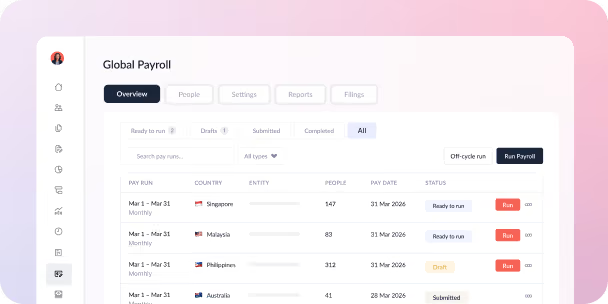
Omni's Applicant Tracking System (ATS) is built for teams hiring across Singapore, Malaysia, and the Philippines, integrated with the same platform that handles onboarding, payroll, and compliance once a hire is made. This means a candidate's journey from application to Day 1 stays in a single system, with no manual data transfer between your recruiting tool and your HRIS.
Our recruitment module handles job posting, pipeline management, structured interviewing, offer management, and onboarding initiation — with AI-powered workflows automating reminders, approvals, and status updates across hiring stages. For teams managing requisitions across multiple countries simultaneously, consolidated pipeline visibility across entities is a significant operational advantage over point-solution recruiting tools.
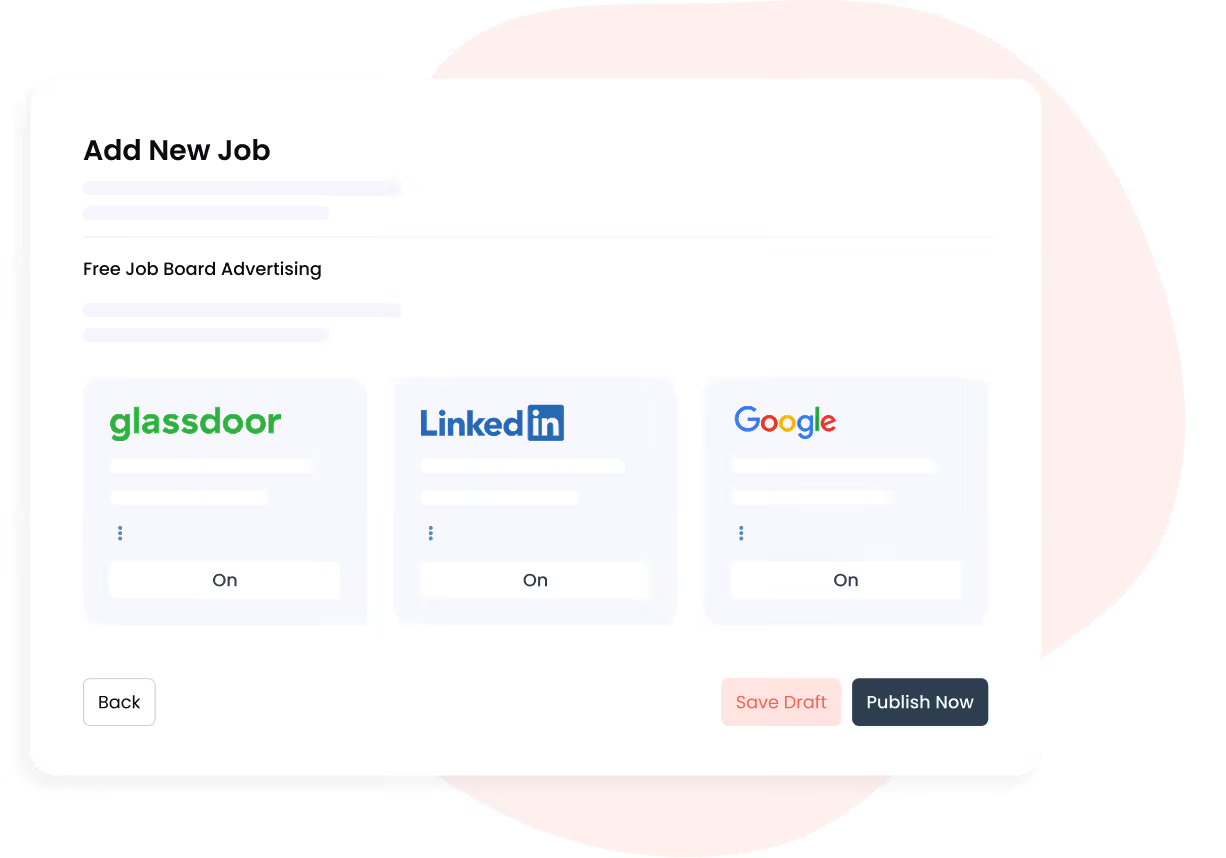
Omni also integrates with leading job boards and third-party AI recruiting tools, so you can layer specialist sourcing or assessment tools on top of a unified HR data foundation. With Mino, Omni's AI agent, hiring managers can also ask workforce questions in plain language — pulling headcount, attrition, and hiring velocity data as instant charts or dashboards, without waiting on a manual report.
.avif)
Why it works for Asia: Hiring data flows directly into payroll and compliance workflows for Singapore (Central Provident Fund), Malaysia (Employees Provident Fund, Social Security Organisation), and the Philippines (Social Security System, PhilHealth, Pag-IBIG), removing the manual data transfer that most standalone ATS tools require.
2. X0PA
Best for: Structured, bias-conscious hiring for enterprises and public-sector agencies across Singapore and Asia
Pricing: Contact for quote
X0PA is an AI recruitment platform specifically designed for the Singapore and broader Asian market. It scores applicants on role fit, retention probability, and performance potential using machine learning trained on structured hiring data, giving your team an objective ranking to work from rather than relying on resume scanning alone.
Public-sector agencies and enterprise employers in Singapore use X0PA to bring auditability into their hiring decisions, which directly supports TAFEP fair hiring compliance. The platform integrates with existing ATS systems and provides structured shortlists, candidate comparisons, and hiring decision audit trails.
Why it works for Asia: Built specifically for Singapore hiring norms and structured to support TAFEP documentation requirements.
3. MokaHR
Best for: APAC recruiting teams managing multilingual candidate pipelines
Pricing: Contact for quote
MokaHR is an AI recruiting platform built for APAC, with multilingual resume parsing that handles Chinese, English, Malay, and other regional languages — an important capability for teams hiring across Malaysia or in markets where candidates apply in multiple languages.
The platform includes regional data residency options, mobile-first candidate experiences, and AI-generated interview summaries that shorten the feedback cycle between recruiters and hiring managers. For companies with significant volume in China or across APAC markets, MokaHR's regional infrastructure and language capabilities are a meaningful differentiator from global-first platforms.
Why it works for Asia: Multilingual resume parsing and regional data residency purpose-built for APAC candidate pipelines.
4. TALENTCLOUD AI
Best for: Southeast Asian SMEs and agencies running high-volume recruitment
Pricing: Contact for quote
TALENTCLOUD AI is a Southeast Asia-based recruitment platform that sources, screens, and matches candidates to roles through predictive matching and systematic hiring workflows. It's particularly well-suited to teams in the Philippines and Indonesia managing large application volumes for operational or BPO roles — markets where speed and consistency of screening are the primary bottlenecks.
Why it works for Asia: SEA-native platform built for the hiring volumes and candidate behavior patterns of the Philippine and Indonesian markets.
5. Manatal
Best for: Regional HR and recruiting teams that need an affordable, AI-powered ATS with APAC relevance
Pricing: From $15/user/month
Manatal is a cloud-based ATS with AI-powered candidate scoring and sourcing that is well-established in Southeast Asia. Its candidate recommendation engine scores applicants against job requirements automatically, and the platform integrates with major job boards active in the region — including JobsDB, JobStreet, and LinkedIn.
At $15/user/month, Manatal is significantly more accessible than enterprise-tier platforms while still offering structured AI shortlisting, pipeline management, and reporting. It's a strong fit for growing teams that need a standalone ATS with regional job board integrations before investing in a fully unified HRIS.
Why it works for Asia: Strong Southeast Asian job board integrations and an accessible price point relative to global ATS platforms.
6. SHL
Best for: Assessment-led hiring in Malaysia and Singapore
Pricing: Contact for quote
SHL is a talent assessment platform with AI-enhanced psychometric testing, skills evaluations, and predictive analytics. It helps your teams in Malaysia and Singapore identify high-potential candidates through objective, data-based evaluations — reducing the reliance on unstructured interviews for early-stage screening.
SHL's assessments are validated across different job families and industries, and the platform produces structured candidate reports that support fairer, more defensible hiring decisions. For roles where cognitive ability, personality fit, or specific technical skills are strong predictors of success, SHL adds a layer of structure that most ATS platforms alone don't provide.
Why it works for Asia: Validated for use across Malaysian and Singaporean hiring contexts, with structured outputs that support TAFEP-aligned fair hiring documentation.
7. HireVue
Best for: Enterprise teams running structured, skills-based video interviewing at scale
Pricing: Enterprise; custom quote required
HireVue is a video interview and evaluation platform used by large organizations to run structured, skills-based hiring at volume. It automates scheduling, hosts recorded video interviews, and provides AI-assisted scoring against structured competency frameworks developed with occupational psychologists.
For teams handling hundreds or thousands of applications annually — graduate hiring programmes, high-volume operational roles, or regional talent drives — HireVue removes the recruiter bottleneck at the initial interview stage without sacrificing evaluation consistency. It supports 40+ languages, making it viable for multilingual hiring across SEA markets.
Why it works for Asia: 40+ language support and structured interview frameworks applicable to competency-based hiring requirements in the region.
8. Paradox (Olivia)
Best for: Frontline, shift-based, and high-volume hiring where candidate experience and speed are the priority
Pricing: Part of Workday suite; contact for quote
Paradox is a conversational AI assistant — known as Olivia — that automates candidate Q&A, initial screening, and interview scheduling through mobile messaging. Rather than directing candidates through an application portal, Paradox meets them where they already communicate: via SMS, WhatsApp, or messaging apps.
For hospitality, retail, logistics, and BPO teams across Southeast Asia — where frontline candidates often prefer mobile-first communication and drop off during lengthy application processes — Paradox's conversational model meaningfully improves completion rates and time-to-screen.
Why it works for Asia: Mobile-first, messaging-led candidate experience suited to frontline hiring in markets where smartphone-first job seekers dominate.
9. Testlify
Best for: Skills-first hiring, high-volume candidate screening, and objective talent assessment at scale
Pricing: From $20/candidate/month
Testlify is an AI-powered talent assessment platform that helps hiring teams evaluate candidates through role-specific skills tests, cognitive assessments, and structured screening workflows. Rather than relying heavily on resumes, Testlify enables employers to assess real-world competencies and compare candidates using standardized, data-driven benchmarks.
For fast-growing companies across Southeast Asia — where hiring teams often need to screen large applicant volumes while maintaining consistency and fairness — Testlify helps reduce manual evaluation effort and identify qualified candidates earlier in the hiring process.
Why it works for Asia: Skills-based assessments and structured screening help organizations manage high application volumes while improving hiring quality across diverse talent pools.
How AI recruiting software handles fair hiring in Asia
One of the most frequently raised concerns about AI in recruitment is bias. AI systems trained on historical hiring data can reflect and amplify existing patterns in who gets hired. For teams in Asia, where fair hiring is both a regulatory requirement and a business priority, this deserves careful evaluation before any tool is adopted.
Here's how the compliance landscape maps across Omni's key markets:
When configured with structured criteria and audit-trail requirements, AI recruiting software supports fair hiring by standardizing screening criteria across all applicants and producing documented, reviewable shortlists. The risk comes from unvalidated models or tools that score against criteria correlated with protected characteristics. Always ask vendors how their models are validated for bias and what controls exist to flag anomalous shortlisting patterns.
How to choose the right AI recruiting software for your team
The right AI recruiting software depends on where your biggest bottleneck sits and how your hiring is structured. Before evaluating vendors, work through these questions:
Is your primary need sourcing, screening, or full-cycle?
Point solutions for sourcing (like X0PA or MokaHR) go deeper on candidate discovery. ATS platforms (like Manatal or Omni's ATS) manage the full pipeline. Knowing which stage is your biggest time sink focuses the evaluation.
Do you run in-country hiring or hire across entities?
Teams hiring across Singapore, Malaysia, and the Philippines simultaneously benefit more from a unified platform than from separate best-in-class tools for each market as the integration overhead and compliance data gaps can compound quickly.
What are your candidate volume and role types?
High-volume, frontline roles (hospitality, BPO, logistics) need conversational AI and mobile-first experiences. Professional and technical roles benefit more from structured assessment and competency-based evaluation. These aren't served equally well by the same tools.
How does recruitment connect to your HRIS and payroll?
The most common source of post-hire data errors is the manual transfer of candidate information from a standalone ATS into your HR system. A unified platform like Omni removes this step entirely as hiring data flows directly into onboarding, payroll, and compliance workflows.
Frequently Asked Questions
AI recruiting software is a platform that uses machine learning, natural language processing, and automation to handle hiring tasks — sourcing candidates, screening applications, scheduling interviews, and evaluating candidates against role criteria. The goal is to reduce recruiter time on high-volume, repetitive tasks so your team can focus on relationship-building, offer management, and candidate experience.
For hiring teams across Singapore, Malaysia, and the Philippines, AI recruiting software reduces screening time on high-volume applications, supports multilingual candidate pipelines, and creates auditable hiring records that align with TAFEP (Singapore), DOLE (Philippines), and Malaysian fair hiring requirements. Platforms built specifically for the region — like X0PA, MokaHR, and Omni HR — handle these requirements natively rather than requiring manual compliance management on top.
Generative AI (GenAI) in recruiting creates content — job descriptions, candidate outreach messages, interview question sets — rather than just analyzing existing data. Earlier AI recruiting tools focused on parsing and ranking (screening resumes, scoring candidates). GenAI tools add the ability to produce structured hiring content at scale, which is particularly useful for teams managing multiple open roles across different markets simultaneously.
AI can reduce the influence of unconscious bias when it's configured to evaluate candidates against validated, role-relevant criteria — and when it produces structured, auditable shortlists that support human review. The risk is that AI systems trained on biased historical data can amplify existing patterns. Before adopting any AI recruiting tool, evaluate how the vendor validates their model for bias, what controls exist, and whether the platform supports the fair hiring documentation required in your markets.
For Singapore-based teams needing structured, TAFEP-aligned hiring: X0PA and SHL are built for this. For multilingual APAC pipelines: MokaHR. For high-volume SEA hiring: TALENTCLOUD AI and Paradox. For teams that want recruitment integrated with their HRIS, payroll, and compliance workflows across SG, MY, and PH: Omni HR connects all of these in a single platform.
No. AI recruiting tools automate the high-volume, repetitive elements of hiring — screening hundreds of applications, scheduling across time zones, sending status updates — so that your recruiters can spend more time on the work that requires human judgment: building candidate relationships, assessing cultural fit, and closing offers. The value of AI in recruitment is in making your existing team faster and more consistent, not in replacing the relationships that drive good hiring outcomes.



.avif)
.avif)