





















.png)
According to MIT, the future workplace hinges upon efficiency, effectiveness and balance. As businesses navigate the post-pandemic landscape, a key focus for HR leaders is building and maintaining a strong talent pipeline.
With increasing workforce mobility and changing priorities, companies are forced to adjust their workforce policies in order to remain competitive. This requires a balance between increasing efficiency and supporting employees in achieving a work-life balance. This then raises the crucial question: What constitutes workplace efficiency, and what are the strategies that companies can put in place to enhance it?
What is work efficiency?
The efficiency of work refers to how effectively and productively tasks are completed. It’s about completing tasks in a smart manner, minimizing wasted time and resources.
A common misconception is that efficiency is all about getting things done. However, the emphasis here is on quality of work. To put it simply, being efficient means producing quality work within specified timeframes, instead of simply working hard.
Why is increasing efficiency important?

No matter the size of your organization, increasing efficiency of work is paramount to achieve success and maintaining a competitive edge.
For employers
Increasing efficiency of work is a golden ticket for employers to unlock benefits that significantly impact its bottom line, workforce, and competitive edge.
In today’s competitive landscape, speed and cost-effectiveness are key to becoming an industry leader. Increasing efficiency of work becomes pivotal for growing businesses to innovate and adapt to changing market conditions.
Efficient workplaces can enhance satisfaction by reducing burnout and create a sense of accomplishment. This leads to increased employee satisfaction and retention rates. Happy employees are also likely to go the extra mile.
For employees
Implementing structured work habits can promote employee motivation and performance as mentioned above, but also fosters a positive company culture.
When employees adhere to efficient work practices, they are able to complete tasks more effectively, meet deadlines, and collaborate easily with colleagues. As a result, employees are more engaged in their work, leading to higher job satisfaction and a more motivated workforce.
Looking for more ways to improve your employee engagement?
Download our HR Calendar 2024 for inspiration!
Ways on increasing efficiency at work
The process of increasing efficiency at work often involves optimizing processes, minimizing wasted time and resources, and achieving maximum output with minimum input.
Here are 10 tips on how you can improve the efficiency of work at your workplace:
1. Organize a to-do list
Writing down tasks increases efficiency of work by enhancing the encoding process. Research has shown that when employees have a plan to complete tasks, it alleviates the anxiety caused by unfinished tasks, known as the Zeigarnik effect. This is why till this day, creating a structured to-do list remains one of the most effective methods when it comes to increasing efficiency.
Aside from prioritizing tasks, to-do lists also ensures that important items are not overlooked. An added advantage of this method is the sense of accomplishment it provides upon checking off the tasks, further boosting employee morale.
2. Remove distractions
Next tip for increasing efficiency of work is to Identify and remove distractions in your work environment. Creating a distraction-free environment enables you to enter a state of flow. This might involve turning off notifications, finding a quiet workspace, or using noise-canceling headphones.
3. Batch similar tasks together
Research suggests that productivity suffers when individuals switch between tasks, resulting in significant time loss.
An effective way to tackle this is by implementing task batching to increase efficiency of work. By grouping similar tasks together, it allows you to streamline workflows and minimize the time spent switching between different types of tasks.
For example, schedule specific times during the day to respond to emails. Instead of checking emails sporadically throughout the day, which can be distracting and disrupt workflow, you can batch this task by setting aside 15-20 minutes in the morning and another 15-20 minutes in the afternoon to respond to emails. This allows you to focus on other tasks at hand without interruptions and can result in overall productivity.
4. Take breaks
Aside from the daily stressors of our personal and professional lives, 15% of working-age adults were reported to struggle with mental health issues in 2019. This further highlights the importance of incorporating mental health days at work.
Additionally, regular breaks as short as short 15-20 minute intervals can aid in sustaining focus and reducing the risk of employee burnout. These breaks can also improve concentration and overall productivity.
5. Clean up your workspace
Next, let’s discuss the importance of organizing your workspace when it comes to increasing efficiency of work.
The Fellowes Workplace Wellness Trend Report highlights that employees value working in a healthy and clean environment. A tidy workspace can lead to a clearer mind and increased efficiency. It’s important to organize your workspace to reduce clutter and improve productivity.
This can include decluttering surfaces, ensuring essential items are easily accessible, and creating a layout that supports your workflow. By creating a clean and tidy workspace, you can enhance your focus and efficiency of work throughout the day.
6. Communicate clearly
Effective communication helps avoid misunderstandings and ensures information is conveyed correctly, leading to timely task completion. Use clear, concise and specific language when conveying your messages.
This is especially important for remote teams, where interactions are often done through digital tools such as Slack. In a remote setting, clear communication can help bridge the physical gap between team members, fostering collaboration and maintaining efficiency of work.
Read next: Navigating the Digital Divide: Enhancing Remote Team Communication
7. Delegate effectively
Delegating tasks to team members can also help lighten your workload and enhance the efficiency of work within an organization.
Effective delegation not only lightens the workload of individuals but also improves overall team productivity and time management. It leverages on the existing skill set of team members while also providing opportunities for them to acquire new capabilities and knowledge. This process enhances the team’s overall adaptability, enabling them to take up responsibilities based on individual strengths and interests.
Delegation also fosters trust and commitment, as employees feel empowered to contribute meaningfully to the team’s goals and company mission. By delegating tasks to those best suited to handle them, organizations can ensure that work is completed to a high standard.
8. Establish realistic goals
Setting SMART goals helps employees maintain motivation and focus as it provides something to work towards and look forward to. They provide a sense of purpose, ownership, and pride when they are realistic.
By breaking down large goals into smaller, more manageable tasks, employees can track their progress and stay on target. This approach not only increases efficiency of work, but also provides a sense of accomplishment as milestones are achieved. Additionally, SMART goals promote clarity and alignment within teams, ensuring that everyone is working towards a common goal or objective.
Celebrating and acknowledging employee efforts when goals are achieved is equally important. This boosts employee morale and reinforces a workplace culture of appreciation and motivation.
Relevant reads: 12 Employee Recognition Examples to Keep Your Team Engaged All Year
9. Develop a routine
According to the World Economic Forum, establishing a routine can have huge benefits in both personal and professional development.
Implementing a daily routine creates structure and improves time management. It also boosts cognitive function and stimulates innovation and creativity. Studies indicate that regular work processes allows employees to spend less cognitive energy on mundane and repetitive tasks, thereby encouraging focus and creativity for more complex tasks and increasing overall efficiency of work.
10. Leverage technology
When increasing efficiency of work, you don’t have to do it manually. Use tools and software to automate repetitive tasks, manage projects, and improve communication.
For example, harnessing AI tools can help HR teams streamline processes, make data-driven decisions, and create personalized experiences for employees throughout the entire employee lifecycle.
Additional reading: The HR Tools Growing Teams Need in 2024
Increasing Efficiency of Work with HRIS

As mentioned, tools like Human Resources Information System (HRIS) play a huge role in increasing efficiency of work. Here’s how:
Automating tasks
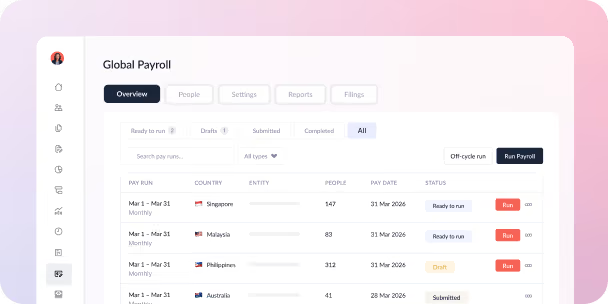
HRIS automates mundane, repetitive tasks such as payroll processing, leave management, performance evaluations and more. It reduces the time and effort required for these activities, freeing up HR professionals to focus on strategic tasks such as talent management, employee development, and strategic workforce planning.
Empowering employees
Some HRIS platforms offer employee self-service portals, which empower employees to access information such as payslips, time off balances and attendance records. Employees can also submit requests, and update their personal information through the portal without HR intervention, thereby increasing data accuracy and employee engagement.
Streamlined data management
HRIS helps in increasing efficiency of work by consolidating employee information, ensuring accuracy and immediate updates across the system.
Having all employee data in a single source simplifies retrieval, saving time and effort for decision-making. Another added advantage is heightened data security as access to sensitive information can be easily controlled and monitored.
Integration with other systems
HRIS platforms allow for integration with other systems, such as accounting or recruitment software, further increasing efficiency by removing the need for manual data entry and ensuring seamless information flow across departments.
Improved reporting
Last but not least, HRIS offers advanced reporting capabilities, enabling HR teams to generate customized reports on metrics such as attrition rates or training effectiveness. These reports provide valuable insights that help in decision-making and workforce planning.
HRIS reports can also assist in monitoring compliance and assessing the effectiveness of HR initiatives. With the help of comprehensive and real-time data, organizations are able to make informed decisions that drive organizational growth and success.
Building a More Efficient Future with Omni
Increasing efficiency of work is crucial for organizations that want to remain competitive and achieve their business goals. However, improving workplace efficiency is an ongoing process that requires commitment and effort from all levels of management. That’s why it’s important to have the right tools by your side to achieve maximum results with minimum effort.
Omni’s fully automated HR platform allows HR teams and managers to create customizable templates that grow alongside your business, molding to each employee’s unique needs and reducing the administrative burden that comes with managing the employee lifecycle.
Our full suite of modules supports every aspect of your business, offering an intuitive and fully customizable platform that integrates with your team’s favorite tools for a seamless and timely adoption.
If you’d like to learn more about how Omni’s all-in-one HR software automates the entire end-to-end employee lifecycle, saving People leaders from administrative tasks and increasing efficiency of work, book a demo with our team!



.avif)
.avif)