


















.png)
Summary. Global payroll solutions are platforms or services that manage compliant employee compensation across multiple countries — handling tax withholding, statutory contributions, currency disbursement, and local reporting requirements from a centralized system. For businesses operating across APAC, where a single workforce can span Singapore CPF, Malaysian EPF, Philippine SSS, and Indonesian BPJS obligations simultaneously, choosing the right global payroll solution isn't just an operational decision — it's a compliance one. This guide covers what to look for, the three models used to deliver global payroll services, and how to evaluate providers for the realities of operating across Asia-Pacific.
Global payroll solutions are platforms or services that manage compliant employee compensation across multiple countries from a single, centralized system. In practice, that means handling tax withholding, statutory contributions, currency disbursement, local payslip formats, and regulatory reporting across every jurisdiction where your employees are based — without managing a separate payroll process in each one.
For businesses expanding across Asia-Pacific, the compliance complexity is significant. APAC covers more than 50 countries, each with its own statutory framework. A company with employees in Singapore, Malaysia, the Philippines, and Indonesia is managing four separate sets of statutory obligations simultaneously: CPF contributions in Singapore, EPF and SOCSO in Malaysia, SSS, PhilHealth, and Pag-IBIG in the Philippines, and BPJS Kesehatan and BPJS Ketenagakerjaan in Indonesia. Each has its own contribution rates, salary ceilings, filing deadlines, and form requirements — and all of them change periodically.
The gap between a generic global payroll solution and one built for APAC shows up in these details. A platform designed around US or European payroll frameworks can accommodate APAC as a configuration layer — but the statutory logic is bolted on rather than built in, and compliance gaps emerge when local regulations update faster than the platform does.
The right global payroll solution for an APAC team handles this complexity natively. This guide explains how to find one.
Why Global Payroll Compliance in APAC Is Uniquely Complex
Before evaluating global payroll solutions, it helps to understand what makes APAC a higher compliance burden than most other regions.
Fragmented statutory frameworks
Unlike Europe, which has some regulatory harmonization through the EU, or North America, where payroll frameworks are broadly similar across markets, APAC has no unifying regulatory layer. Each country sets its own employment law, social security system, tax regime, and reporting requirements independently. Even neighboring markets with cultural similarities — Singapore and Malaysia, for example — have completely different statutory contribution structures, different payslip format requirements, and different filing timelines.
This fragmentation means every market you add to your APAC footprint adds a distinct compliance obligation. A global payroll solution needs to handle each one correctly without treating any as a low-priority afterthought.
Frequent regulatory changes
APAC's fast-growing economies generate frequent regulatory updates — new tax rates, updated contribution ceilings, revised form submission methods, changes to leave entitlements. Malaysia's Employment Act 2022 amendments changed overtime eligibility thresholds, extended paternity leave, and formalized flexible work requests. Singapore updated its CPF Ordinary Wage ceiling from S$7,400 to S$8,000 in January 2026. The Philippines has updated SSS contribution schedules multiple times in the past five years.
A global payroll solution that requires manual rate updates after each regulatory change is one that will eventually fall behind. Auto-updating compliance logic is the baseline for any serious APAC payroll platform.
Leave and benefits variation across markets
Even a straightforward entitlement like maternity leave varies dramatically. A Singapore citizen employee is entitled to 16 weeks, 8 of which are government-paid. A Philippine employee is entitled to 105 days, fully paid. These differences directly affect PTO balances and payroll calculations — and they must be applied correctly for each employee based on their jurisdiction, not a regional average.
Multi-currency complexity
An APAC payroll covering four or five markets means managing the same number of currency exposures per pay cycle. Volatile exchange rates, different banking settlement timelines, and foreign currency transfer restrictions can all affect whether employees are paid accurately and on time — before even accounting for the reconciliation complexity when payroll data feeds into multi-currency accounting systems.
The Three Models for Delivering Global Payroll Solutions
Global payroll services are delivered through three distinct models, each with a different tradeoff between control, cost, scalability, and compliance depth.
1. In-house local payroll teams
Some organizations build dedicated payroll teams in each country they operate, with deep local expertise and direct control over payroll processes.
Strengths: Maximum control, deep local knowledge, direct relationships with tax authorities and statutory bodies, fast response to country-specific issues.
Limitations: High cost to establish and maintain, difficult to scale as you enter new markets, resource-intensive, processes often vary across countries creating inconsistencies at a consolidated level.
Best for: Large enterprises with established, permanent operations in a small number of APAC markets where payroll volume justifies the overhead.
2. Partner-based payroll services
Many organizations work with a network of local payroll vendors in each country, coordinated centrally. The head office manages the overall payroll strategy while local partners handle country-specific compliance and disbursement.
Strengths: Leverages established local expertise, enables faster market entry than building in-house teams, reduces direct compliance liability in each market.
Limitations: Less direct control over data and process quality, data consistency issues when employee information lives across multiple vendor systems, coordination overhead across time zones and SLAs, vendor quality varies across markets.
Best for: Companies entering new APAC markets quickly who need local compliance coverage before they've built internal expertise, or organizations that prefer managed services over software ownership.
3. Centralized platforms with built-in local compliance logic
Modern global payroll solutions build unified platforms that embed country-specific compliance rules directly into the system. Statutory rates, filing requirements, and form templates are maintained by the platform and updated automatically when regulations change.
Strengths: Consistent data and processes across all markets, real-time visibility into global payroll in one dashboard, automatic compliance updates, easier scaling as you add markets, fewer vendor relationships to manage.
Limitations: Requires a platform that genuinely covers your specific APAC markets with local depth — not all global payroll platforms support every country equally.
Best for: Growing APAC businesses that need to scale across multiple markets efficiently, want consistent compliance without managing a vendor network, and benefit from payroll being connected to the broader HR system.
Integrated HRIS vs. standalone payroll tools
Within the centralized platform model, there's a further distinction: integrated HRIS platforms versus standalone payroll tools.
Standalone payroll tools process salaries and statutory contributions accurately — but employee data, leave balances, attendance, and expense claims live in separate systems and must be manually reconciled each cycle. Every data touchpoint is a potential error source.
Integrated HRIS platforms connect payroll directly to leave management, attendance, expense claims, and employee records. When a leave balance changes, payroll recalculates automatically. When a salary adjustment is approved in the HR system, it flows into the next payroll run without manual re-entry. For multi-country teams, this integration removes the most common source of payroll errors: fragmented data across disconnected systems.
Global Payroll Delivery Models Compared
How to Evaluate Global Payroll Solutions for APAC
When comparing platforms and providers, these are the criteria that matter most for an APAC-first business.
APAC market coverage depth
Not all global payroll platforms cover APAC markets with equal depth. Ask specifically about the markets you operate in — not just whether the platform "supports" them, but whether statutory contributions are calculated natively, whether forms are generated in the correct format for local tax authorities, and whether the platform has a local team that monitors regulatory changes and pushes updates proactively.
A platform that covers Singapore and Malaysia well but treats the Philippines and Indonesia as limited-support markets will create compliance gaps at exactly the moment you're trying to scale.
Automatic compliance updates
Any vendor you evaluate should be able to answer clearly: when statutory contribution rates or form requirements change in Singapore, Malaysia, or the Philippines, how quickly does your platform update — and does it happen automatically or does our team need to configure the change?
Integration with your HR system
A global payroll solution that connects natively with your HR platform means leave balances feed directly into payroll without manual exports, salary changes sync into the next payroll run automatically, and statutory calculations draw from the same employee records your HR team manages. Fewer system boundaries means fewer reconciliation errors.
Compliance risk tolerance and audit readiness
Determine how much compliance risk your business can absorb, and look for providers who match your threshold through accurate statutory calculations, strong audit processes, timely filings, and the ability to generate documentation on demand when a tax authority or labor ministry makes an inquiry.
Local support in your markets
Payroll compliance questions are often time-sensitive. A provider with a Singapore-based support team that operates in APAC business hours can respond to an urgent CPF query on a Tuesday afternoon. A provider whose nearest expertise is in a different timezone cannot. For APAC operations, local support availability is a practical compliance risk factor — not just a service preference.
Reporting and visibility
At minimum, a global payroll solution should give you real-time visibility into payroll costs, statutory contribution status, and filing deadlines across all markets in a single view. Strong platforms generate audit-ready reports for each jurisdiction automatically — so you're not assembling documentation under pressure when a regulatory inquiry arrives.
Read next: Global Payroll Compliance: Complete Guide →
How Omni HR Delivers Global Payroll Solutions for APAC
Omni is an all-in-one HRIS and multi-country payroll platform built specifically for growing companies across Asia. Local compliance for Singapore, Malaysia, the Philippines, Hong Kong, and Indonesia is built into the core — not configured as an afterthought.
%201.avif)
What that means in practice:
- Statutory contributions (CPF and SDL in Singapore; EPF, SOCSO, EIS, and HRDF in Malaysia; SSS, PhilHealth, and Pag-IBIG in the Philippines; MPF in Hong Kong) are calculated automatically at current rates, with updates applied when regulations change
- Leave management, attendance, expense claims, and employee records connect directly to payroll — no manual exports, no reconciliation across systems
- Payslips are generated in MOM-compliant, EA form-compatible, and BIR-aligned formats automatically per market
- A local support team across APAC operates in your timezone and understands the statutory requirements in each market
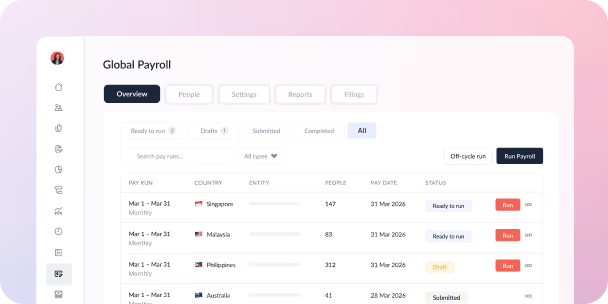
- Multi-country payroll runs from a single dashboard — one pay cycle, one reconciliation, one view of your full APAC payroll cost
- Employer of Record (EOR) services for markets where you don't yet have a legal entity
For businesses expanding beyond a single APAC market, Omni scales without requiring a new platform for each country. The same system that runs Singapore payroll runs Malaysia payroll, Philippine payroll, and Hong Kong payroll — with local compliance logic built in for each.
"Having a single source of truth has improved the accuracy of our data and reporting."— Shux M., Chief People Officer, Endowus
"If you're a growing company, you should consider Omni. Even with jurisdictions in the US and UK, you can utilize this platform because they can be compliant with the technical laws."— Andrei Perevalovi, Head of People Products, Virtual Internships
See how Omni handles global payroll for APAC teams →
Essential Questions to Ask Global Payroll Providers
Use these when evaluating any global payroll solution for your APAC operations:
- Which APAC markets do you cover, and what does "support" mean specifically — are statutory contributions calculated natively or do we configure them?
- How quickly do you update the platform when statutory contribution rates or filing requirements change in Singapore, Malaysia, or the Philippines?
- Does payroll connect directly to leave management and attendance, or do we export data manually each cycle?
- What does your support model look like for APAC — do you have local teams in the region, and what are your response SLAs?
- Can you generate IR8A, EA forms, BIR 2316, and other statutory documents automatically?
- How do you handle multi-currency payroll — what's the process for exchange rate management and payment timing?
- What does your audit trail look like, and how quickly can you produce documentation for a regulatory inquiry?
- Do you conduct statutory filings on our behalf, or do you generate the files and we submit them?
Related reading:
Frequently Asked Questions
Global payroll compliance is the process by which a business adheres to the labor laws, tax regulations, and statutory reporting requirements that govern employee compensation in every country it operates. It covers tax withholding, social security and retirement contributions, worker classification, leave entitlements, data privacy obligations, and filing deadlines — all of which vary by jurisdiction and change regularly. Non-compliance can result in financial penalties, legal action from employees or regulators, and reputational damage.
Compliant payroll software embeds statutory contribution rates, filing requirements, and labor law rules directly into the payroll process — so calculations are made at current rates automatically, filings are generated in the correct format for each jurisdiction, and regulatory updates are applied without manual intervention. For APAC specifically, this means platforms like Omni HR handle CPF in Singapore, EPF and SOCSO in Malaysia, SSS/PhilHealth/Pag-IBIG in the Philippines, and MPF in Hong Kong from a single system — with local compliance logic built into the core rather than configured as an afterthought.
The risks are direct and concrete. Financial penalties vary by country but can be substantial — the IRS alone issued over $8.5 billion in employment tax civil penalties in 2023. Beyond fines, non-compliant payroll can trigger audits, create personal liability for company directors in some jurisdictions, generate employee disputes over unpaid or incorrectly calculated statutory contributions, and damage the employer brand in markets where you're trying to attract talent.
The terms are used interchangeably in most contexts. "Global payroll" typically refers to the overall system or strategy for managing payroll across multiple countries, while "international payroll" often refers to the mechanics of processing payroll for employees in countries other than the company's home jurisdiction. In practice, both describe the same operational challenge: paying employees accurately and compliantly across multiple regulatory environments.
For companies managing local payroll across these three markets, the best fit is a platform with CPF, EPF, SOCSO, EIS, SSS, PhilHealth, and Pag-IBIG calculations built natively into the payroll engine. Omni HR handles all of these within a single system, alongside full HRIS functionality. For EOR-based hiring without local entities, Deel and Remote are strong options.
A global payroll solution is a platform or service that manages compliant employee compensation across multiple countries from a centralized system. It handles salary calculations, statutory contribution deductions, tax withholding, currency disbursement, and regulatory reporting for each jurisdiction where employees are based — without requiring a separate payroll process per country. For APAC teams, this means a single system handling CPF in Singapore, EPF in Malaysia, SSS in the Philippines, and MPF in Hong Kong simultaneously.
Global payroll software is a platform your team operates to process payroll across multiple countries. Global payroll services typically refers to a managed model where a provider processes payroll on your behalf. Many modern platforms — including Omni HR — offer both: self-service software for teams that want to run payroll in-house, and managed payroll services for teams that prefer to outsource the execution while retaining oversight and visibility through the platform.
Start with coverage depth — not all global payroll providers support APAC markets equally. Verify that the provider covers your specific markets natively, that compliance updates are automatic, and that local support is available in your timezone. Then evaluate integration with your HR system, the quality of reporting and audit documentation, and the total cost of ownership including setup, ongoing fees, and the hidden cost of compliance errors from manual processes.
Yes. Omni provides multi-country payroll across 190+ countries, with dedicated local compliance built in for Singapore, Malaysia, the Philippines, Hong Kong, and Indonesia. Statutory contributions, tax filings, and local payslip formats are handled natively within the same platform that manages leave, performance, attendance, and employee records. Book a demo to see how it handles payroll across your specific APAC markets.
This varies by market. Singapore requires CPF contributions and SDL. Malaysia requires EPF, SOCSO, EIS, and HRDF. The Philippines requires SSS, PhilHealth, and Pag-IBIG. Hong Kong requires MPF. Indonesia requires BPJS Kesehatan and BPJS Ketenagakerjaan. Each has its own contribution rates, salary ceilings, and filing timelines. A genuine APAC global payroll solution handles all of these natively and updates them when regulations change. See our country-specific guides linked below for detailed breakdowns.



.avif)
.avif)